

The Business Owner's Blueprint: Building Usable, High-ROI AI Solutions for MSMEs and Enterprises
 Yahya Bandukwala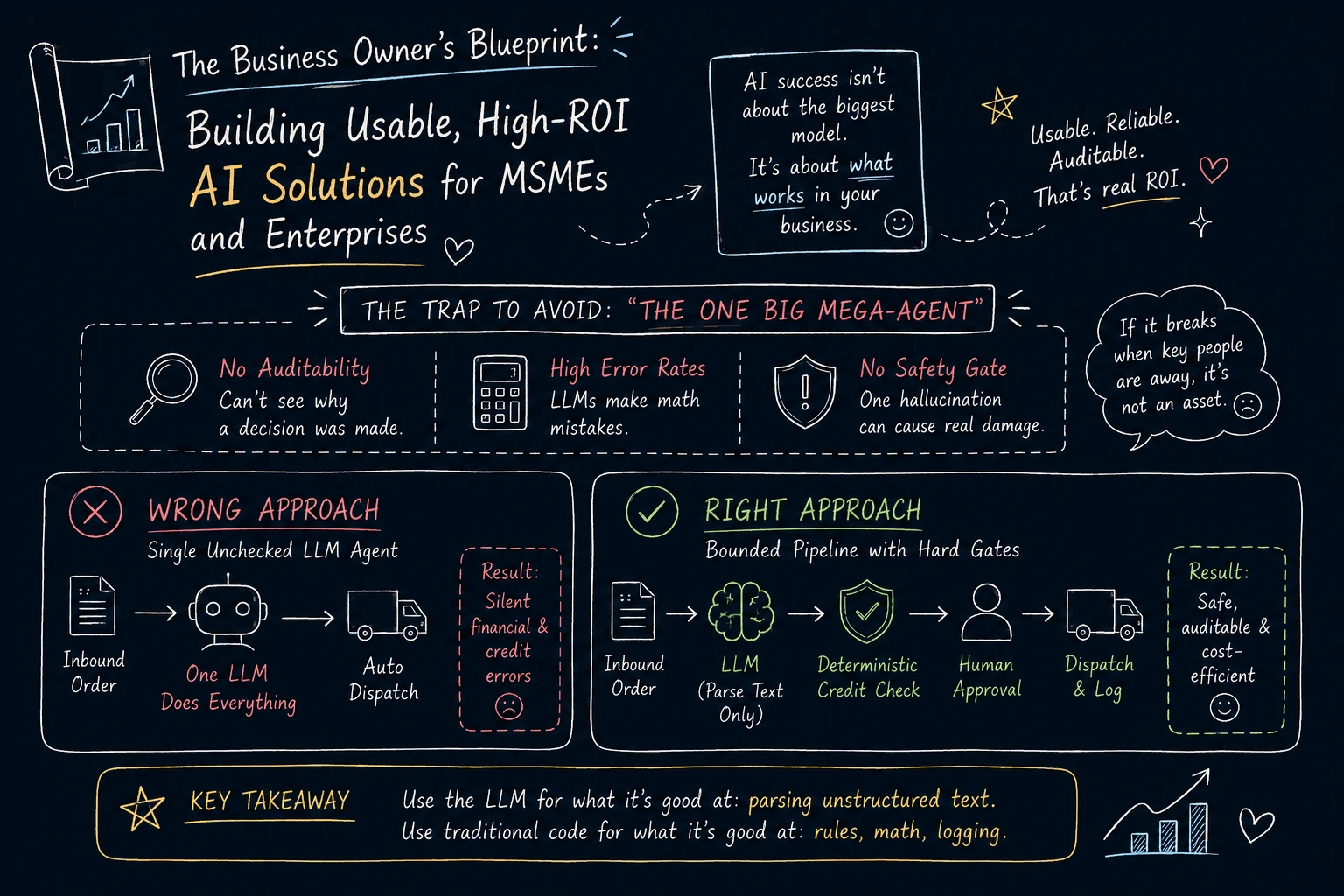
Key Takeaways
Instant Summary- Building one big mega-agent for everything is the single fastest way to fail an AI project and burn your budget.
- Practical AI implementation keeps rules and math in deterministic code while using AI only for unstructured inputs.
- A hypothetical MSME case study (inspired by real patterns) shows how a business can modernize from paper records to an AI-powered system under a tight monthly budget.
Many business owners and executives feel overwhelmed by the noise surrounding Artificial Intelligence. They see headlines about multi-billion dollar AI investments, but when they try to adopt AI in their own operations, projects often stall or deliver poor results.
During the Scaler Forward Deployed Engineer (FDE) masterclass simulation, we analyzed enterprise and MSME modernization scenarios.
The biggest lesson for business leaders is simple: successful AI adoption is not about buying the most expensive model. It is about building a usable system grounded in real operational constraints.
(If your AI solution cannot run smoothly when a key manager is on leave, or if it hallucinates customer data, it is not an asset. It is an operational hazard.)
The Trap to Avoid: “The One Big Mega-Agent”
When companies start an AI project, they often fall into the Mega-Agent Trap. They try to build a single AI bot and tell it: “Read our invoices, check customer credit, predict inventory, and dispatch orders.”
This approach fails almost every time because:
- No Auditability: You cannot see why an LLM made a specific financial decision.
- High Error Rates: Asking a language model to do strict math leads to calculation errors.
- No Safety Gate: A single hallucination can dispatch an order to a customer who has unpaid bills.
| Wrong Approach | Right Approach |
|---|---|
|
Single Unchecked LLM Agent Inbound Order → One LLM Does Everything → Auto Dispatch Result: Silent financial and credit errors |
Bounded Pipeline with Hard Gates Inbound Order → LLM (Parse Text Only) → Deterministic Credit Check → Human Approval → Dispatch & Log Result: Safe, auditable, and cost-efficient |
Use the LLM for what it is good at: parsing unstructured text. Use traditional code for what it is good at: enforcing exact rules, running math, and logging decisions.
Hypothetical Case Study: Mehta Textiles & Co.
Note: This scenario is inspired by real MSME modernization patterns observed across the industry. The company name, numbers, and details are entirely hypothetical and do not represent any specific real organization.
Consider Mehta Textiles & Co., a mid-sized fabric trading company with an annual turnover of approximately Rs. 8 crore. Like many Indian SMEs, they run their operations across WhatsApp messages from dealers, manual entries in a local ERP, and Excel sheets for credit tracking.
Here is how a Forward Deployed Engineer would design a usable, high-ROI AI system for a business like this:
1. Unstructured Intake to Structured Data (The AI’s Job)
Dealers send WhatsApp messages and voice notes in regional language saying things like “bhai 200 metre grey cotton chahiye, kal ka delivery”. An LLM is used strictly to parse this unstructured message into structured fields: item, quantity, delivery date, and dealer ID.
2. Strict Credit Rules (Traditional Code’s Job)
The business has a credit exposure limit of Rs. 3 lakh per dealer. Instead of asking an AI to guess credit safety, traditional code checks the dealer’s outstanding balance in the database. If the balance exceeds the limit, the system flags the order automatically.
Never let an LLM decide whether a customer's credit is safe. That decision must always be handled by deterministic code with hard-coded business rules.
3. Human-in-the-Loop Guardrail
If the order parse confidence is low or the credit limit is breached, the order is routed to the owner’s phone for a 1-tap approval before anything is dispatched or confirmed to the dealer.
4. Cost Discipline
By reserving LLM calls only for parsing ambiguous orders, the entire cloud system runs for a modest monthly infrastructure cost, delivering strong ROI without runaway API expenses. This kind of discipline is what separates a deployable AI system from an expensive prototype.
The Business Owner’s Checklist for AI Projects
Before approving an AI project for your business, ask your team these four questions:
- Where does AI belong vs. traditional code? Keep credit rules, accounting, and inventory math in standard code.
- What is the human approval rule? Low-confidence or high-risk actions must require human sign-off.
- What is our per-query run cost? Ensure API expenses scale predictably with your revenue.
- Is our data kept private? Ensure customer data is hosted in enterprise accounts with zero public training.
Read the Full Series
This article concludes our 3-part series on Forward Deployed Engineering and modern AI architecture:
- Part 1: The Fall of the Siloed Specialist: How AI Compression Is Forcing the Rise of the Forward Deployed Engineer
- Part 2: Beyond “Vibes Coding”: The 6 Core Pillars Every AI Architect Must Master
- Part 3 (Current): The Business Owner’s Blueprint: Building Usable, High-ROI AI Solutions for MSMEs and Enterprises
Practical Workplace AI Upskilling with CareerNovara
Building usable, high-ROI AI solutions requires combining practical domain understanding with structured system design.
At CareerNovara, we provide practical training and 1:1 mentorship for professionals and team leads to master zero-coding workplace AI tools:
- AI for Awareness & Productivity Bootcamp: Join our 11-day practical hands-on cohort at /bootcamp.
- Live AI Professionals Webinar: Learn practical AI frameworks and career positioning at /webinar.
- 1:1 AI Career Coach & Prompt Generator: Test interactive workplace prompts at /coaching.
- Chat on WhatsApp to discuss workplace AI coaching or team upskilling.